
What Ealing Homeowners Get Wrong About Party Wall Notices Before Starting an Extension
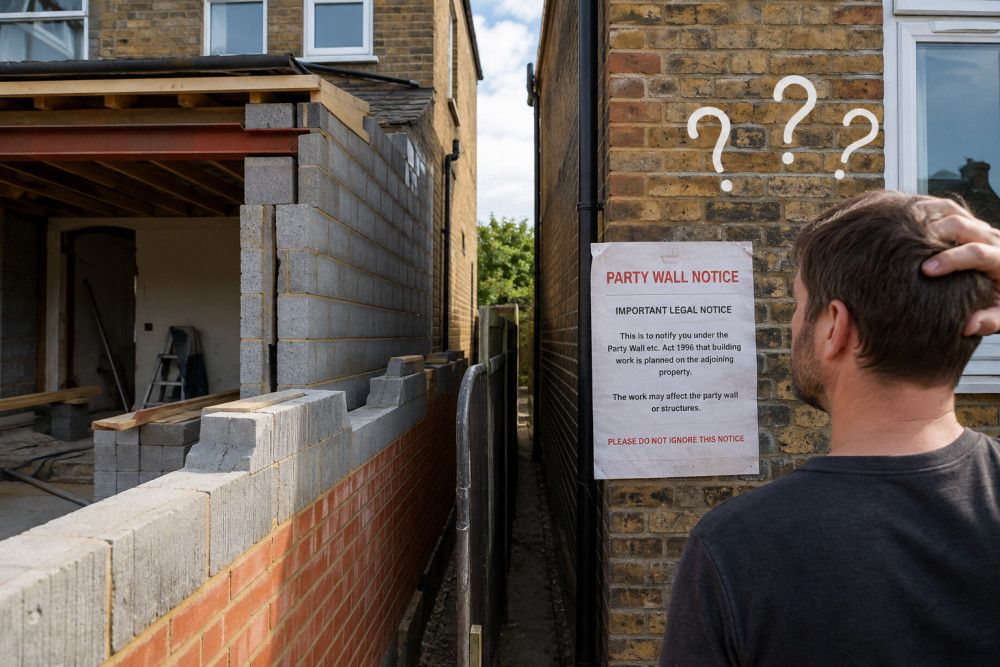
Ealing's terraces and semis — especially the Edwardian and Victorian stock around West Ealing, Northfields and Pitshanger Village — share party walls almost universally. Most loft conversions, rear extensions and basement digs in the borough trigger the Party Wall etc. Act 1996, whether the homeowner realises it or not, and anyone unsure where they stand is usually better off speaking to a party wall surveyor in Ealing before drawings are finalised rather than after work has started.
The most common mistake is serving the notice too late — after the drawings are finished and a contractor start date is already agreed. There are three notice types under the Act, and which one applies depends on the works: a Party Structure Notice for building on or altering the line of junction wall itself, a Line of Junction Notice for new walls built up to (but not on) the boundary, and a Section 6 notice for excavation near a neighbouring building. Homeowners often only think about the first type and miss that their new footings trigger the third.
Neighbours get a minimum notice period under the Act: one month for most works, two months for structural work to a party wall or excavation covered by Section 6. Once served, a neighbour has three options — consent in writing, do nothing, or dissent. Doing nothing for 14 days is treated as a dissent, which surprises a lot of people who assume silence means agreement. Once there's a dissent, either a single Agreed Surveyor acts for both owners, or each owner appoints their own surveyor and the two of them appoint a third in case of disagreement. Either route ends in a Party Wall Award — a document setting out what work can happen, when, and what protections apply to the neighbouring property.
Leave the notice too late and the build date often slips six to eight weeks while surveyors get appointed and the Award gets sorted. That's the single biggest scheduling risk on a domestic extension in Ealing, and it's avoidable simply by serving notices as soon as the design is fixed, rather than waiting until planning permission or building control approval comes through.
Excavation notices get underestimated too, particularly on Ealing's narrow plots. If a new foundation is dug within three metres of a neighbouring building and goes deeper than the neighbour's existing foundations, a Section 6 notice applies. That catches a lot of single-storey rear extensions with new footings, not just basements. It's easy to miss if you're only thinking about the loft conversion when notices come up — the foundation works for a modest rear extension can trigger the same notice requirement as a basement dig, just with a shorter run-up.
Schedules of condition matter more than most homeowners expect going in. A proper pre-works schedule, with dated photos of the neighbouring property inside and out — walls, ceilings, floors, any existing cracks — is what protects both sides if a crack or settlement issue turns up mid-build. Without one, it's very hard to prove whether damage was caused by the works or was already there. Skip it, and that's usually what turns a minor dispute into a long one, sometimes running well past practical completion while surveyors argue over causation instead of just referring back to a dated photo.
Cost is the other thing people underestimate. The building owner pays for the surveyor(s) on both sides — their own and the adjoining owner's, if the neighbour chooses to appoint separately rather than share an Agreed Surveyor. Fees vary with the number of adjoining owners and the complexity of the works, but a straightforward single-neighbour rear extension is a different job, and price, from a basement affecting three or four adjoining properties along a terrace.
None of this needs to hold a project up if it's handled at the right point. The issues that cause delay are almost always the same: notices served too late, a Section 6 trigger missed because attention was on the more obvious party wall, or no schedule of condition in place before work starts. Getting the notice period, the right notice type, and the schedule of condition right at the start is what keeps a project on programme.
New ealing Jobs Section Launched!!
Vacancies updated hourly!!
Click here: ealing jobs
Share: